

Direct air capture (DAC) relies on Vaisala CO2 sensors
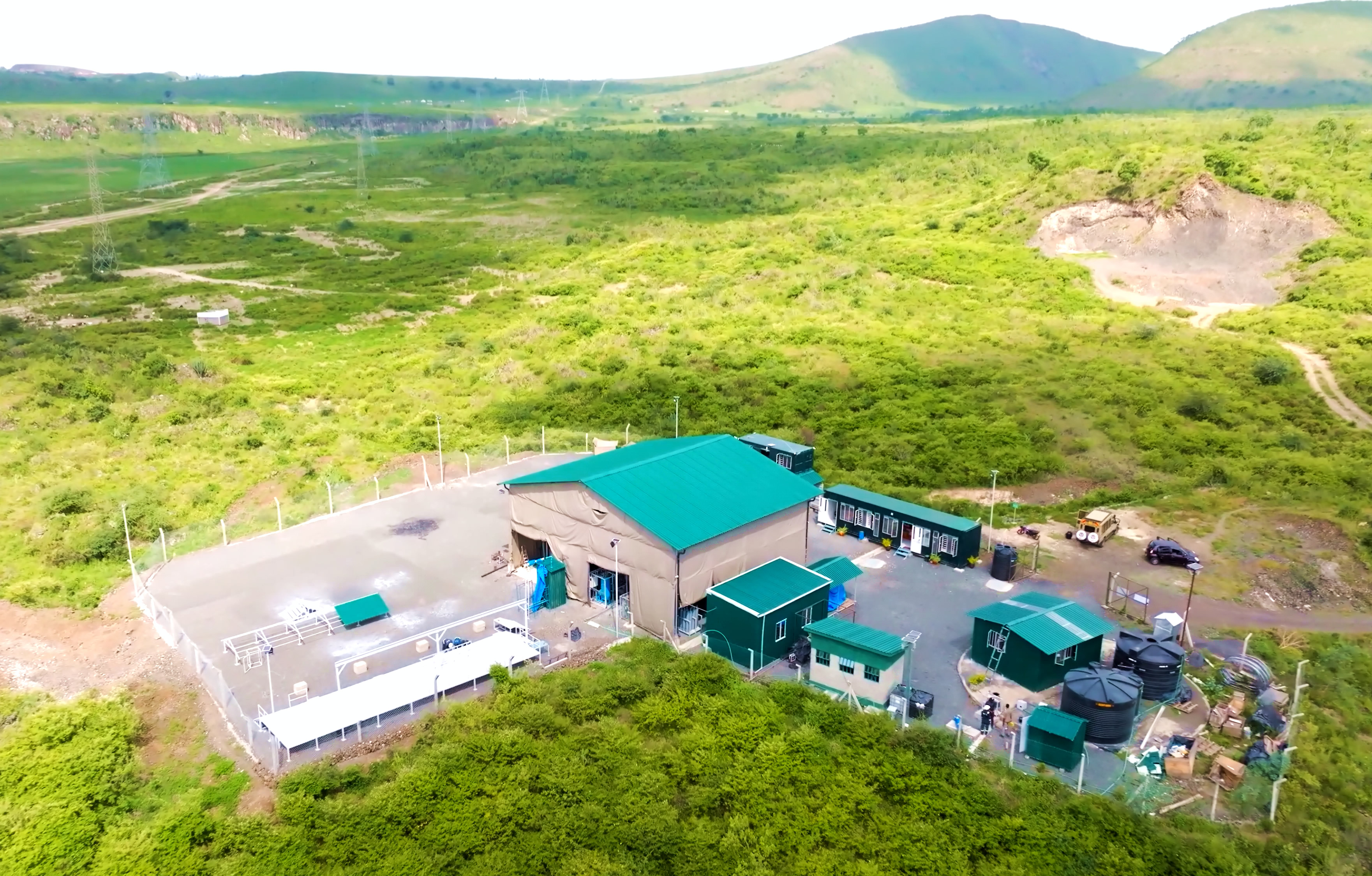
Octavia Carbon's direct air capture (DAC) facility in Kenya

Vaisala GMP343 measures ppm level CO2 at the inlet and outlet of the DAC plant with high accuracy and precision

Octavia Carbon's Direct Air Capture Plant
Vaisala carbon dioxide sensors enable process control & CO2 capture verification in Octavia Carbon Direct Air Capture (DAC) project in Kenya
The DAC process requires energy, so to deliver a net reduction in GHGs, the energy supply should be carbon neutral. Here, Kenya has a significant advantage because the Great Rift Valley offers enormous potential in geothermal energy.
After capturing CO2 directly from ambient air, Octavia liquifies the gas and transfers it to a partner for permanent underground geological storage.
The success of DAC is heavily dependent on the efficiency with which it is able to remove CO2 from the air, so accurate CO2 measurements are critically important.
Octavia offers a number of Carbon Dioxide Removal (CDR) packages which enable organisations to make philanthropic donations and/or offset their carbon emissions. In addition, organisations participating in Carbon Trading are able to purchase CDR Credits directly from Octavia.
CO2 measurement challenge
Conscious of the requirement to develop a DAC process that is as efficient as possible, Octavia’s optimization team needed to be able to take accurate inline measurements at every stage of the process. In addition, verification of Octavia’s carbon capture process can only be possible with accurate reliable CO2 measurements.
Octavia staff tried and discarded several products from CO2 sensor manufacturers before adopting Vaisala’s. Khamis Mwalwati Muniru, Process Optimization Lead at Octavia, explains. “Within my team, we rigorously test materials to assess their CO₂ capture efficiency. This process demands precise CO₂ monitoring across a broad concentration range, spanning from 0-100% vol during CO₂ release phases, and to below 400 ppm during CO₂ capture which necessitates exceptional measurement accuracy.”
Khamis found that some sensors were able to measure accurately at some concentrations, but not all, and that reliability became an issue with some sensors. “We need to be able to accurately measure carbon dioxide levels from an ambient concentration of around 430ppm all the way up to captured CO2 at 99.99%,” he says. “Vaisala’s were the only sensors capable of delivering the required accuracy across such a wide range.”
In addition to measurement accuracy, Khamis’s team also required measurement stability. “Our DAC is essentially a batch process, which means that sensor measurements vary from very low to very high over a short period of time – typically around one hour. We discovered that some of the initial (now discarded) sensors lost accuracy over a single cycle, which had two important consequences. Firstly, we had to conduct frequent laborious, time-consuming recalibrations, and secondly, most importantly, we could not rely on the measurements to identify the point at which the sorbent was fully saturated.”
Vaisala’s solution was found to be ideal for carbon capture
Octavia’s process optimization team evaluated Vaisala’s GMP343 carbon dioxide probe and found it to be ideal for their application. “In addition to a wide range, we also required high accuracy below 400ppm, which was not possible with most of the sensors that we tried.” Khamis explains. “So we were delighted to discover that the GMP343 could achieve this with ±3 ppm accuracy and long-term stability. Happily, this meant that we did not have to recalibrate before every test.”
The GMP343 employs Vaisala’s CARBOCAP® technology, a silicon-based non-dispersive infrared (NDIR) single-beam, dual-wavelength sensor with no moving parts – designed for accuracy and long-term stability.
In addition to the GMP343, Octavia also employs the Vaisala MGP241, which was developed specifically for carbon capture processes, delivering reliable measurements in wet and harsh conditions. Measuring inline with automatic temperature and pressure compensation, the range of the MGP241 extends from 0...100 vol-% CO2 and also employs CARBOCAP® technology for long-term stability. The MGP 241 was found to be ideal for measurements after adsorption.
Octavia Carbon’s DAC process has three main phases – Adsorption, Desorption and Liquefaction/Injection.
In the first phase, ambient air (̴ 430ppm CO2) is pulled into the DAC machine where it passes through a filter containing chemical sorbents. These chemicals selectively bind with CO2, effectively removing it from the air, until the filter material becomes fully saturated.
In the desorption phase, indirect heat under vacuum is applied to the filter material causing it to release the concentrated CO2, which is extracted. This process regenerates the filters for reuse.
In the final stage, the captured CO2 is compressed and cooled, which causes it to liquify so that it can then be transported to secure geological sites where it is injected deep underground into appropriate rock formations. Under these conditions, and given time, the CO2 gradually mineralizes through a process known as carbonation, and becomes permanent rock.
Octavia has a target of 1,000 tonnes of CO₂ captured annually by the first commercial-scale plant (Project Hummingbird) by 2026, and is aiming for over a million t/yr by 2030.
Summary
Vaisala’s Product Line Manager Antti Heikkilä says: “Our unique CO2 probes were developed specifically for challenging applications such as this. However, with ‘Taking Every Measure for the Planet’ as our Core Purpose, this project is a perfect example of the ways in which Vaisala’s measurement technology is helping to fight climate change.”
“Ultimately, the role of DAC will be dictated by the cost/tonne of CO2 captured,” Khamis explains. “We are fortunate in the Rift Valley to benefit from carbon-free geothermal energy, but the scalability of our technology will depend heavily on process optimization.”
Accurate and reliable CO2 measurements are essential for both the process optimization and operational teams at Octavia Carbon. Without accurate measurements, it would not be possible to select and improve sorbent performance. Similarly, accurate measurements enable effective process control, allowing operational staff to identify the exact moment of sorbent saturation.
Importantly, it is essential that Octavia’s customers have full confidence in the accuracy and reliability of the CDR that they purchase. This will be underpinned by third-party accreditation, but that also entirely depends upon accurate CO2 measurements.
Industrial Measurements
Vaisala
+358 5 8989491
EMEA.media@vaisala.com
Visit us on social media:
LinkedIn
Legal Disclaimer:
EIN Presswire provides this news content "as is" without warranty of any kind. We do not accept any responsibility or liability for the accuracy, content, images, videos, licenses, completeness, legality, or reliability of the information contained in this article. If you have any complaints or copyright issues related to this article, kindly contact the author above.
